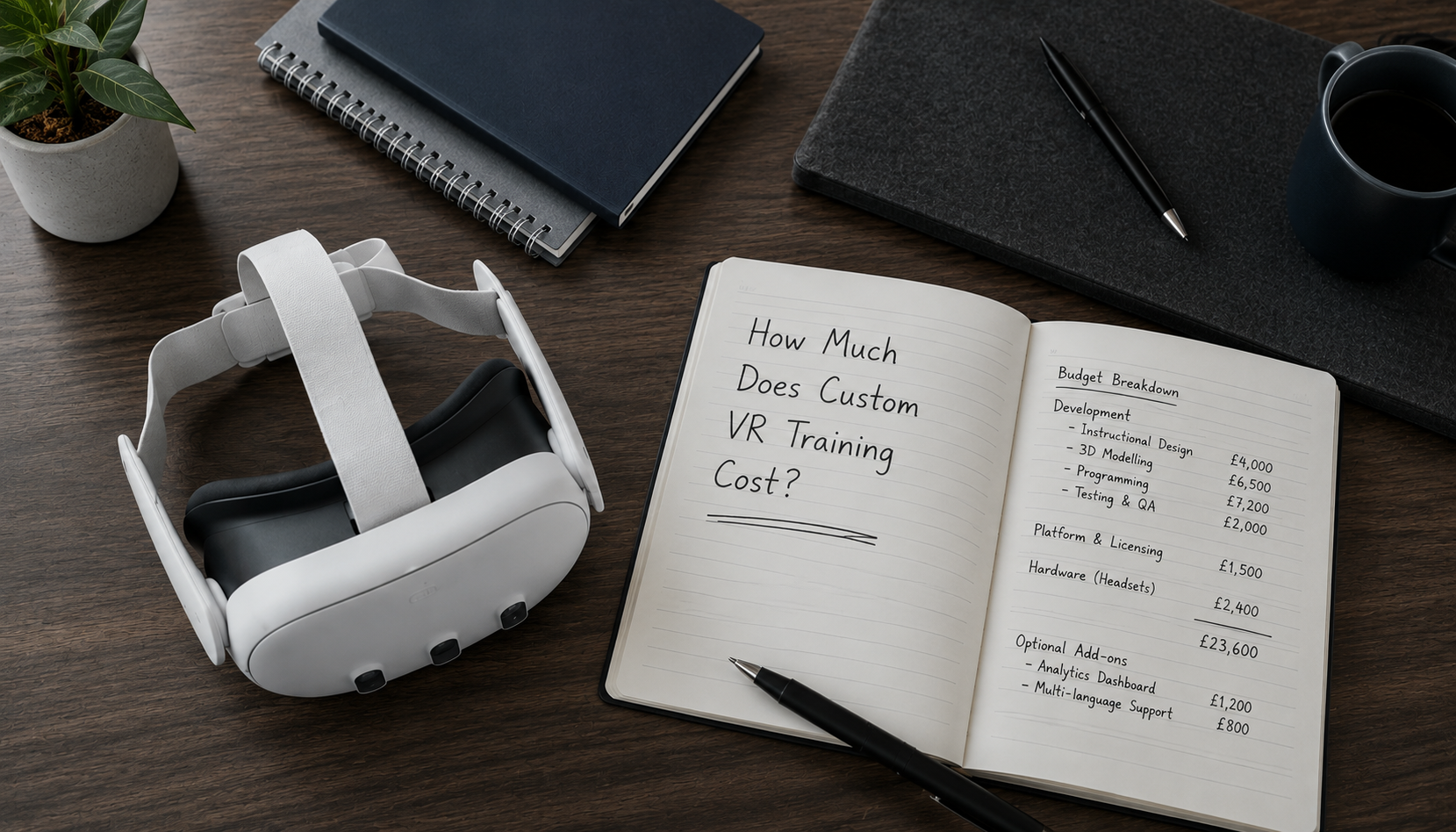
Custom VR training typically costs somewhere between £40,000 and £350,000, depending on what you need it to do. That's a wide range, and there's a good reason for it, as no two projects are the same. This guide explains what drives the price, what you can realistically expect at different budget levels, and how to think about whether the numbers work for your organisation.
Where to start
Custom VR training is not cheap to build. It is, on the other hand, cheap to run. That distinction is what makes it worth looking at seriously.
The upfront development cost covers everything needed to get it built; the virtual environment, the 3D assets, the interactive scenarios, the feedback systems, and the deployment infrastructure. Once that's done, you can run the training with as many people as you like, as many times as you like, with no additional cost per person.
That's a very different cost model to classroom training, where every session has a cost; instructor time, room hire, materials, travel. It scales linearly. VR doesn't.
£40k–£80k
entry-level — single module, one environment
£80k–£200k
mid-range — multiple scenarios, LMS integration
£200k+
complex — multi-environment, enterprise deployment
What drives the cost?
The price of a custom VR training project comes down to how much work is involved in building it. Here are the main things that affect that.
It helps to know where the money goes before looking at the individual cost drivers. Based on data from developers with hundreds of combined VR training projects, content development makes up roughly 70% of the total upfront cost. Within that, 3D art and environment building typically accounts for around 60% of development effort, with the interaction and scenario logic taking up most of the rest. The virtual environment itself is usually the single biggest line item, which is why the complexity of your physical space and the fidelity of your equipment have such an outsized effect on the overall budget.
The virtual environment and 3D assets
Building a convincing virtual environment takes time. If you need a photorealistic recreation of your actual facility (with your specific equipment, layout, and branding) that takes longer than a generic lab or workshop. If the assets can be built from CAD drawings or reference photography you already have, that helps. If everything has to be built from scratch, it costs more.
3D asset quality is one of the biggest single factors in the overall budget. A highly detailed, physically accurate model of a piece of specialist equipment takes significantly longer to build than a stylised approximation. Getting this right is worth it; if the equipment looks wrong, the training feels wrong. But it's a conversation worth having with your development partner about what level of fidelity is needed.
Interactions and scenario logic
A VR module where the learner watches a guided walkthrough is much cheaper to build than one where the learner has to make decisions, complete steps in order, and receive specific feedback based on what they do. The more the simulation needs to respond to the learner's actions, the more development time goes into building that logic.
Branching scenarios (where different choices lead to different outcomes) add complexity quickly. So does anything involving physics simulation, like picking up and manipulating objects in a realistic way. If your training requires this kind of fidelity, it's worth budgeting for it properly. This is usually where the learning happens, so it's not an area to cut corners.
Hardware and supporting equipment
Most custom VR training is now built for standalone headsets, which don't require a PC or additional setup to run. The Meta Quest range is the most widely used platform in enterprise training, and it's what we build for. Standalone headsets typically cost between £250 and £1,000 per unit depending on the model and specification.
If your use case requires higher visual fidelity than a standalone device can provide (detailed surgical simulation, for example, or environments where graphical accuracy is safety-critical) a PCVR setup connects the headset to a dedicated computer. The total cost for headset plus a VR-ready PC runs from roughly £1,500 to £2,500 per station. These setups are less portable and more expensive to manage, but the visual output is substantially better.
Hardware is generally a smaller part of the total budget than people expect. The number of headsets you need depends on how you're delivering the training; a small team using shared devices during scheduled sessions needs far fewer than a large distributed workforce training independently.
It's also worth building in a budget for supporting equipment that often gets overlooked at the scoping stage:
- Headset accessories (replacement face cushions, controller straps, lanyards): £30–£150 per device
- Charging and storage carts for multi-headset deployments: £800–£1,800 per cart
- Sanitisation equipment (UV or wipe-based cleaning systems): £500–£1,500 depending on setup
- Wi-Fi infrastructure upgrades if your site can't reliably stream content over the air
None of these are large costs individually, but together they can add a few thousand pounds to a deployment that wasn't budgeted for them.
LMS integration and analytics
If you need the VR training to connect to a learning management system (so you can track completion, pass rates, and individual performance) that integration adds time and cost. The same applies to custom analytics dashboards. This is worth doing for any programme that needs to generate evidence of competency, but it's worth confirming what data you need before scoping it.
Ongoing maintenance
A custom VR training programme isn't a one-time project; it needs to be maintained as your procedures, equipment, or regulations change. Industry benchmarks put ongoing support at around 15–25% of the original build cost per year. If the training is tied to compliance requirements that are updated regularly, this is an important cost to factor in from the start.
Typical price ranges in 2026
These are real-world ranges based on what custom VR training projects cost to build, not theoretical figures. Every project is different, so treat these as starting points rather than fixed prices.
| Project type | Typical cost (GBP) | Timeline | What's included |
|---|---|---|---|
| Pilot / single module | £40,000 – £80,000 | 10–14 weeks | One environment, single scenario, basic feedback, standalone headset build |
| Mid-range programme | £80,000 – £200,000 | 14–20 weeks | Multiple scenarios or modules, branching logic, LMS integration, assessment module |
| Complex / enterprise | £200,000 – £400,000+ | 20–28 weeks | Multi-environment build, custom 3D assets, enterprise deployment, full analytics, train-the-trainer |
One thing that sometimes catches people out: the discovery and scoping phase (typically 4–6 weeks before any build starts) is usually included in the overall project cost, but worth confirming. The figures above are for the build itself; hardware, ongoing support, and content updates are separate.
The cost over time
Custom VR training carries a real upfront cost. What changes the picture is what the training costs to run across its lifetime.
A Forrester study commissioned by Meta found that enterprise organisations using VR training achieved a 219% return on investment over three years, with the initial investment paying for itself in under six months. That's an enterprise average; your results will depend on your learner volume, how often training needs to be delivered, and what you're currently spending.
The clearest way to think about it: classroom training has a cost every time you run it. VR training has a cost when you build it, and near-zero marginal cost after that. Research puts the crossover point at around 375 learners, at which scale VR training starts to be cheaper per head than the equivalent classroom programme. At 3,000 learners over three years, it typically costs around 52% less per person.
A useful way to look at this: take what you currently spend per person per year on the training you're looking to replace (including instructor time, materials, room hire, travel, and the cost of people being off the floor), multiply it by your learner volume, and compare it to the build cost spread over three years. For most organisations training more than a few hundred people, the numbers are closer than you'd expect.
Another useful way to frame it is cost per person. Based on industry data, the average cost per participant in a custom VR training programme typically falls somewhere between £40 and £160 across the full run of the programme, depending on learner volume and how complex the build is. That number drops considerably in year two, as the content is already built and you're essentially just running it. One analysis across a 1,000-learner deployment found the per-person cost in year one came to around £160, compared to roughly £1,000 for the equivalent classroom programme; by year two it had fallen to around £90 per person, while the classroom cost stayed flat.
~£160
per person in year 1 (VR, 1,000 learners)
~£1,000
per person equivalent classroom cost
~£90
per person in year 2 as content is reused
When is the cost worth it?
Custom VR training isn't the right answer for every training problem, and I'd rather be straight about that than oversell it.
It tends to work well when:
- Your training is specific to your equipment, environment, or procedures, meaning off-the-shelf content simply won't cover what you need
- You have a significant recurring training cohort; the more people you train, and the more often, the lower the per-person cost becomes
- The cost of a poorly trained person is high, whether that's safety incidents, compliance failures, equipment damage, or wasted materials
- Training consistency is hard to achieve; distributed teams, multiple sites, reliance on individual instructors who vary in quality
- You need documented evidence of competency, for regulatory purposes, sign-off processes, or internal quality standards
It's probably not the right fit if you need to train a small group once, if the skills involved are entirely generic (and well covered by existing content), or if you need something ready in a few weeks. Custom builds take time.
Ways to keep the cost manageable
Custom VR training doesn't have to be approached as a single large upfront commitment. There are a few things that consistently make the investment more manageable without compromising the quality of the output.
- Start with a focused use case. The most common mistake is trying to build too much in one go. A tightly scoped first module (one procedure, one environment, one training problem) is faster to build, easier to validate, and gives you real data to make the case for expanding. Most organisations that go wide too early end up with something that does a lot of things adequately, rather than one thing well.
- Consider off-the-shelf content for generic skills. If part of your training covers standard topics that don't need to reflect your specific environment (basic health and safety, induction content, compliance awareness), pre-built VR content is available at a fraction of the custom build cost. Reserve the custom budget for the parts that genuinely require it.
- Phase the build across financial years. A good development partner will scope a phased project where you build the core module first, prove it works, and then commission additional scenarios or environments in subsequent phases. This spreads the cost and lets each phase be informed by what you learned from the last one.
- Negotiate maintenance terms upfront. Ongoing support typically runs at around 15% of the original build cost per year. Agreeing on the scope and pricing of maintenance before the project starts tends to be cheaper than creating new agreements later, particularly if your procedures or regulations change regularly.
- Lease rather than buy headsets for pilots. If you're running a pilot programme with a small group before committing to a full rollout, leasing headsets keeps the hardware cost variable rather than fixed. It also lets you upgrade to a newer device model if the pilot runs across a hardware generation change.
What to ask before you get a quote
Getting a useful quote starts with being clear about what you need. These are the questions worth thinking through before you approach a development partner.
- What is the training meant to achieve? Not 'what will people do in the headset', but what skill or behaviour change are you trying to produce. The more specific this is, the more accurately a developer can scope the build.
- How many people will use it, and how often? This directly affects the cost comparison and also shapes decisions about deployment; how many headsets, what management tools, what reporting.
- What does your current training cost to run? This is often harder to answer than it sounds (especially once you factor in trainer time, materials, room hire, travel, and time off the floor), but it's the only way to make a fair comparison.
- Do you need it to connect to an existing system? LMS integration, single sign-on, HR system connections; these add scope. Know what you need before you start.
- What evidence of competency do you need to produce? Some organisations need detailed pass/fail data per learner. Others just need proof of completion. The answer changes what the build needs to include.
On getting estimates
Be cautious of quotes that arrive without a proper discovery conversation. A good development partner will want to understand your training problem before giving you a number. The cost depends on what you need. A quote that arrives quickly without questions tends to be either very rough or based on assumptions that may not apply to your situation.
The scoping conversation is where a lot of the value happens. It's where you find out whether what you want is achievable, whether your timeline is realistic, and whether there are ways to phase the build that make the initial investment more manageable.
We're always happy to have that conversation without any pressure to commit. If you'd like to talk through your situation and get a realistic sense of what something might cost, get in touch and we can go from there. You can also read more about our custom training service.
Related Reading
Sources
- Forrester / Meta – The Total Economic Impact of Meta Quest for VR Training
- Roundtable Learning – How Much Does VR Training Cost in 2026?
- VR Vision Group – VR & AR Development Cost in 2026: Real Enterprise Pricing
- VR Vision Group – What Does VR Training Cost? A Clear-Cut Guide to Adoption
- EducationXR – VR Training ROI: What Enterprise Buyers Need to Know in 2026
- AgileSoftLabs – AR/VR Enterprise Training: The Actual Cost Breakdown 2026
- VirtualVerse Studio – VR App Development: Real Timelines, Real Costs, Real Scope
Let's talk
Get a realistic sense of what your VR training project would cost.
We scope every project properly before giving you a number — no pressure, no generic quotes. Let's talk through your situation.
Let's scope your project