Blog
How Are Companies Using AR and VR for Product Demonstrations? (2026 Examples)
This guide looks at how companies across automotive, medical devices, retail, real estate, and industrial manufacturing are using AR and VR to demonstrate products at scale, and what separates the implementations that work from those that don't.
Quick Answer
Companies are using AR and VR for product demonstrations to give buyers a realistic, interactive experience of a product before they commit to a purchase. Industries using this most actively include automotive (virtual showrooms and test drives), medical devices (surgical equipment simulation), industrial manufacturing (complex machinery demos), and retail (room visualisers). Brands using immersive demos report up to 30% higher conversion rates and reductions in product returns of 22-40%.
Why traditional product demonstrations fall short
Product marketing has always had the same underlying challenge: the closer a customer gets to experiencing a product, the more likely they are to understand it. The further they are from that experience, the more they're guessing.
For most products, closing that gap used to mean getting the product in front of the customer, or the customer in front of the product. That works reasonably well for simple, portable items. It starts to break down when products are large, specialist, environment-dependent, or expensive to move. A brochure cannot show how a surgical light behaves mid-procedure. A video cannot convey the scale of a piece of industrial machinery. And physically transporting a 200kg operating theatre fixture to every sales meeting is not realistic.
AR and VR solve this by putting the customer inside an experience of the product, without the product needing to be present.
75%
of top brands use AR/VR in marketing
$75.9bn
AR market forecast by 2030
30%
average conversion uplift from VR demos
What AR and VR mean in this context
These two technologies are often grouped together but they work differently, and the right choice depends on what you're trying to do.
Virtual reality (VR) removes the physical world entirely and replaces it with a digital environment. The user puts on a headset and is fully inside the product experience; exploring, interacting, adjusting. The product does not need to exist physically. This is useful for large, complex, or environment-dependent products.
Augmented reality (AR) overlays digital content onto the real world, typically through a phone, tablet, or lightweight glasses. A customer might point their phone at their living room and see exactly how a piece of furniture would look in that space. AR is more accessible (no headset required) but offers less immersion.
Both serve the same goal: reducing the gap between seeing a product and understanding it well enough to buy it with confidence.
How companies are using AR and VR for product demonstrations
Automotive
Volvo was an early mover here, building a VR experience that let potential buyers take a virtual test drive of the XC90 without visiting a dealership. Buyers could explore the interior, understand the features, and get a first-person sense of the car before speaking to anyone.
This changed the nature of the sales conversation. By the time a buyer sat down with a salesperson, they were already familiar with the product. Other automotive brands have followed, using VR at trade shows to demonstrate models not yet in physical stock, and in showrooms to offer configurations that could not be kept on the floor.
Medical devices and surgical equipment
For manufacturers of large or specialist medical equipment, physical demonstrations are often genuinely impractical. The equipment may need a clinical environment to function properly, require professional installation before it can be assessed, or be too expensive to transport routinely to customer sites.
This was the situation facing Dr. Mach GmbH and Co. KG, a German manufacturer of surgical lighting systems. Their products are designed for operating theatres, and the value of the lighting is only clear when you see how it behaves in a real clinical environment. We built a virtual operating theatre where potential customers can explore the lighting system directly; repositioning the lights, adjusting settings, and seeing the effect in real time. The result is a demonstration that travels in a carry-on bag and delivers the same experience every time. Read the full Dr. Mach case study.
Retail and furniture
IKEA built virtual environments that let customers walk through fully rendered kitchens and living spaces, seeing how furniture looks and fits together before buying. Rather than trying to imagine how a sofa might look at home, customers could place themselves inside a realistic version of that space and explore it.
The shift from isolated product viewing to contextual experience has a direct impact on purchase confidence and return rates. When someone has already seen how something looks in a room, they are much less likely to be disappointed when it arrives.
Real estate
Platforms like Matterport allow estate agents and property developers to offer immersive walkthroughs that buyers can explore remotely. Rather than relying on static photographs and floor plans, buyers can move through a space at their own pace and build a real sense of scale, layout, and atmosphere.
This has been particularly valuable for international buyers and for early-stage shortlisting, removing the need for travel before a buyer has decided a property is worth seeing in person.
Industrial and manufacturing
In industrial sectors, products are often too large, too complex, or too context-dependent to demonstrate in a traditional setting. A piece of heavy manufacturing equipment might require the buyer to understand how it integrates with their existing production line, not just what it does in isolation.
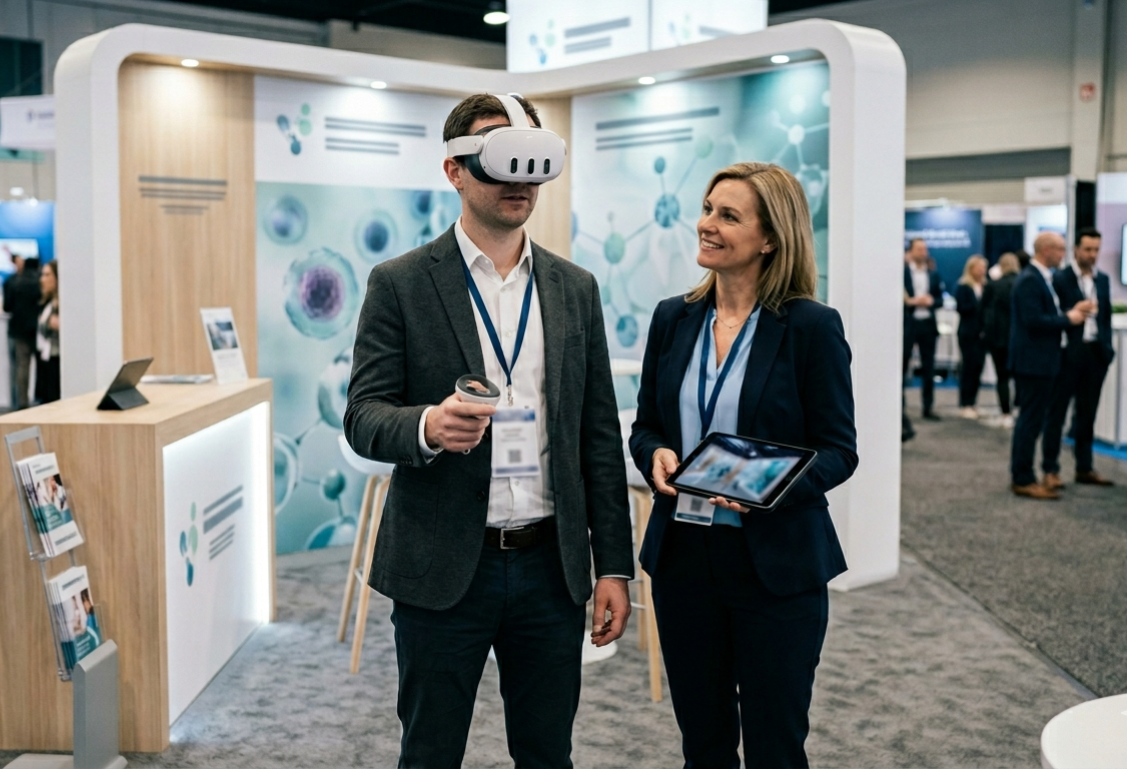
VR allows manufacturers to build interactive simulations of machinery, letting buyers explore operational workflows, see how equipment interfaces with other systems, and step through safety procedures. This is useful at trade shows, where logistics rule out physical demonstrations but the need to communicate technical complexity remains.
Why the format works
What connects all of these examples is that the technology is being used to give the customer an experience of the product rather than a description of it. That shift matters more than it might sound.
When someone puts on a headset and explores a product for themselves, they are not being told about features. They are discovering them. Research from PwC found that people process information up to four times faster in immersive environments compared with traditional methods. For product marketing, that translates into buyers who arrive at purchase decisions with less friction and fewer unanswered questions.
- Presence: VR creates a sense of being inside the experience rather than observing it from outside. This builds product familiarity much faster than passive content.
- Interaction: the more a customer engages with a product, the more invested they become in understanding it. Passive formats (video, brochure) don't create this.
- Consistency: physical demonstrations vary depending on who delivers them and under what conditions. Immersive experiences remove that variability.
- Scale: a physical demo in Tokyo requires a flight, a hotel, and the product. A VR demo in Tokyo requires a headset.
The commercial picture
Companies using VR for product demonstrations report up to 30% higher conversion rates compared with traditional demo methods, and a 22-40% reduction in returns among buyers who experienced the product in VR before purchasing. Sales cycles for complex or high-value products also tend to shorten, as buyers arrive at later-stage conversations with fewer questions and more confidence.
There is also a straightforward cost argument. Physical demonstrations require transport, setup, staff time, and logistics. A VR experience is built once and used indefinitely, with no per-demonstration variable cost. For any organisation running regular product demonstrations, the unit economics shift considerably once the initial development cost is covered.
Where to start
The most useful starting point is not 'how do we do VR' but 'where does our current demonstration process fall down?' The answer to that question usually points directly to where an immersive approach would have the most impact.
Products that are large, environment-dependent, technically complex, or expensive to transport are the clearest candidates. So are situations where demonstration consistency across different sales teams or geographies is difficult to achieve.
Most organisations start with a single focused use case; a trade show tool, a sales aid for a specific product line, or a way to demonstrate something that currently cannot be shown at all. From there, the scope tends to grow as it becomes clear what the format can do.
If you are working out whether this applies to your product, the starting question is simple: would experiencing your product directly change how a customer evaluates it? If yes, it is worth exploring. Our step-by-step guide to using VR for product demos covers exactly how to take that next step.
Related Reading
Let's talk
Could your product benefit from an immersive demonstration?
We design and build AR and VR product demonstrations for equipment manufacturers, medical device companies, and industrial brands. Let's explore what's possible.
Contact Us