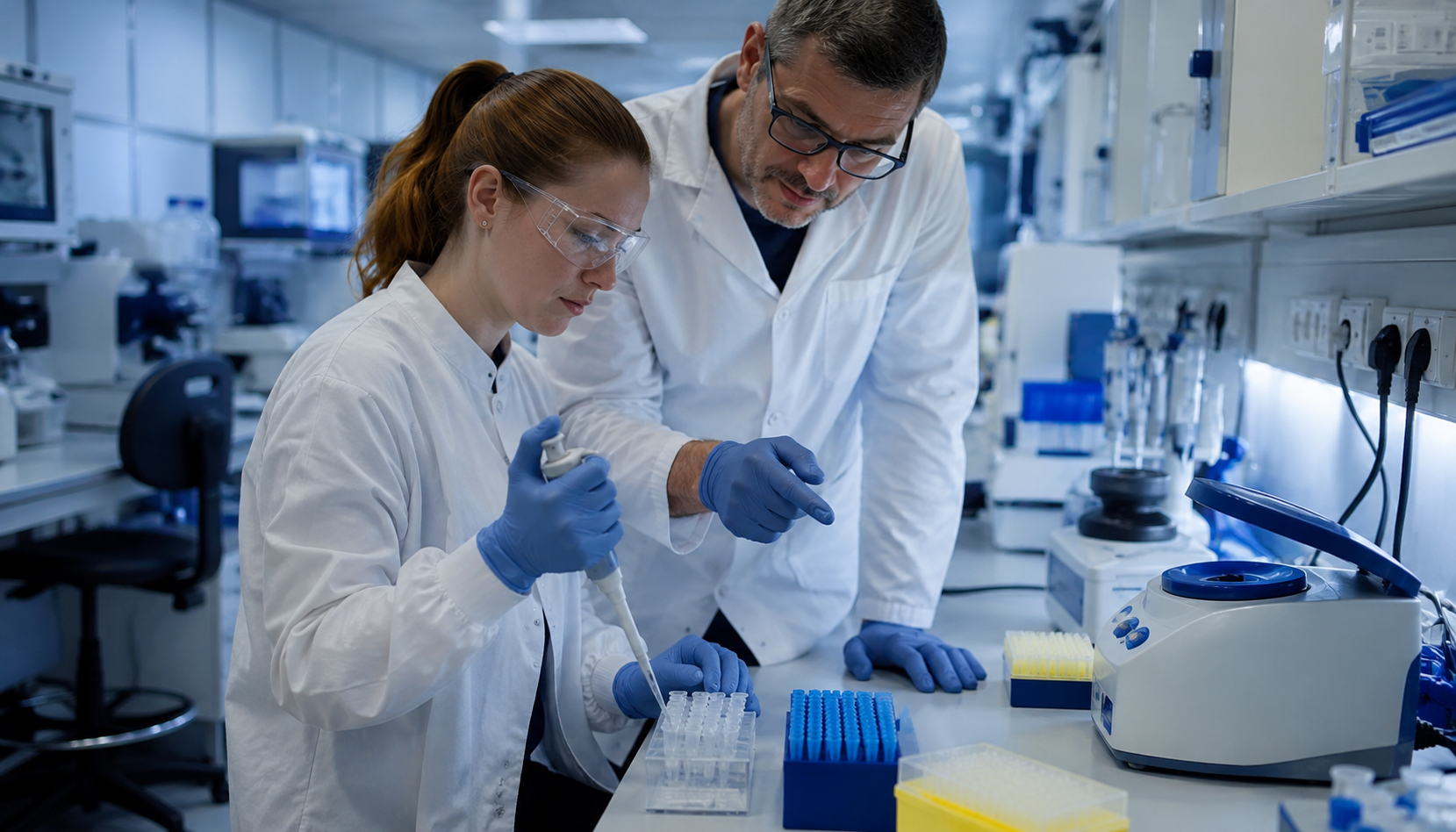
CROs and biotechs are shortening lab training time with VR by giving new scientists a way to practise delicate techniques before they ever touch real equipment. Rather than consuming expensive reagents during the learning phase or tying up a senior scientist for weeks of supervised practice, learners build physical confidence in a simulator first, then bring that foundation to the bench. The result is a shorter path to independent work and a more consistent baseline across the team.
This post looks at why getting a new scientist up to speed takes as long as it does, what the evidence shows about immersive training in lab settings, and what's worth thinking about before committing to it.
Why the practical learning curve is hard to shorten
Laboratory techniques are kinaesthetic. Pipetting, cell culture, aseptic work, PCR setup: you can read about all of these, watch someone perform them, and still need considerable practice before you can do them reliably yourself. The skill is in the physical execution, and that only becomes reliable through repetition.
In a busy CRO, the conditions for that kind of guided repetition are rarely ideal. Lab schedules are tight, equipment is in use, and the scientists who would ordinarily supervise a new starter have their own projects to deliver. Most people get an initial walkthrough, a period of supervised practice, and then they're expected to find their footing. That's fine for candidates who already have strong technique. For those who don't, it's a slow and expensive period for everyone involved.
Three things that slow the process down
Reagent consumption during the learning phase
Every practice run uses consumables. For protocols involving expensive reagents or limited biological material, that waste adds up quickly. Labs routinely underestimate consumable usage by 20 to 40 percent in the first month, particularly in PCR, qPCR, and cell maintenance work. The cost isn't just financial; it's also in lost time when samples have to be replenished or experiments restarted because an early run produced unusable results.
In CROs working with client samples or compounds at early stages of development, this is particularly difficult to absorb. You can't easily replace a sample that took months to produce.
Technique that varies by who taught it
Reproducibility in biopharma research breaks down most often not in the design of experiments, but in how they're carried out. Small differences in timing, pipetting angle, mixing speed, or setup steps create results that don't replicate between scientists, shifts, or sites. A 2026 analysis from JoVE put the annual cost of irreproducible preclinical research in the US at between $28 billion and $40 billion. Much of that traces back to variation in how techniques are passed on during training.
When each new starter learns from whoever is available that day, and when different supervisors do things slightly differently, that inconsistency gets built in from the start. The technique then persists across experiments long after the training period ends.
The supervisor time problem
The person best placed to train a new scientist is typically one of the most experienced people in the lab. Every hour they spend supervising a new hire is an hour not spent on the projects they're actually there to deliver. For a CRO with a high-throughput model and multiple new starters joining across the year, that creates a real and recurring drain on the team.
It also means the quality of training depends heavily on who's available. When supervisors are under pressure, the training that new starters receive tends to get compressed. They get through the essentials and not much more.
What immersive training changes
Immersive training, whether VR or AR simulations that replicate lab procedures in a virtual environment, addresses all three of these problems to varying degrees.
A new scientist can practise a protocol in a simulator before they pick up a real pipette or open a cell culture flask. Because no physical reagents are consumed, the practice sessions are effectively cost-free. They can run through a procedure ten times, make mistakes, receive feedback at the point the mistake happens, and correct their technique before they ever touch the real equipment.
The feedback is also standardised. Rather than receiving instruction from whoever happens to be free, every learner goes through the same steps with the same guidance. Technique is taught consistently from the first session, rather than varying by supervisor or by how much time that supervisor has available.
And because learners are building the foundations of their technique before they reach the bench, the supervised sessions that follow tend to be shorter and more productive. The supervisor is correcting specific errors rather than teaching from scratch.
What the evidence shows
A proof of concept conducted by Körber at a European pharmaceutical manufacturer gives a useful indication of what's possible. Employees mastered new tasks 44 percent faster using AR-guided workflows compared to paper-based instructions. GMP compliance in the facility increased by 25 to 40 percent, the time needed to check batch records fell by 60 percent, and overall production output rose by 30 percent. The trial also found that new operators could get to grips with the guided workflow system in one to two days, compared to up to 45 days without AR support.
Körber are transparent about the limitations: this was an exploratory proof of concept rather than a controlled study, and the numbers should be read as directional rather than definitive. That said, the scale of the differences is large enough to be worth paying attention to.
Thermo Fisher Scientific has built a dedicated training centre with five VR-equipped rooms capable of running 20 employees at a time. Their stated objective is to reduce total training time by 50 percent, with VR used specifically to bring new staff up to speed on sterile injectable production lines. (Source: HR Dive)
44%
faster on new tasks with AR-guided training vs paper (Korber)
25-40%
increase in GMP compliance in Korber proof of concept
$28-40bn
estimated annual cost of irreproducible preclinical research in the US (JoVE)
The techniques it works best for
Not every lab skill translates equally well into a VR simulation. The techniques that benefit most are ones where the physical execution is the primary challenge, where what separates a good result from a poor one is the way the procedure is performed, rather than the interpretation of results.
In a CRO or biotech context, that covers a substantial range: pipetting and serial dilutions, aseptic technique and cell culture, PCR and qPCR preparation, working with multichannel pipettes, and instrument setup for common assays. These are the procedures new starters need to build confidence in quickly, and they're the ones where early errors tend to carry forward into later results.
Techniques that involve a great deal of judgment, interpretation of ambiguous outputs, or highly variable physical conditions are harder to simulate well. VR is most useful where there's a clear right way to do something that can be taught consistently.
What to think about before getting started
A few things are worth considering before committing to immersive lab training.
- VR works best as preparation, not as a replacement for hands-on practice. The research is consistent: learners who use VR before supervised sessions perform better than those who don't, but they still benefit from time with real equipment. The goal is to shorten the supervised practice period and make it more productive, not to skip it.
- Off-the-shelf versus custom. There are platforms covering common lab procedures. We build PipetteSim™ for micropipette training, for instance, which works well for that specific technique across different lab settings. Where your protocols differ from standard practice, your equipment is specific, or your SOPs have been developed internally, a custom simulation built around your actual workflow will outperform anything generic.
- The upfront build cost versus the ongoing saving. Custom VR modules have an upfront development cost. The case for them gets stronger the more people you're putting through the same training, and the more expensive the reagents they'd otherwise be consuming during the learning phase. Labs that run high volumes of new starters, or that work with particularly costly materials, tend to find the numbers work more quickly.
Immersive training works best when it's part of a planned programme rather than something added on afterwards. What it does well is compress the early part of the learning curve, the weeks when new scientists are still building the physical confidence they need to work independently. That's usually where the most time, and the most reagent, gets spent.
Related Reading
Sources
- Korber Pharma: Pharma training with augmented reality (proof of concept)
- JoVE: Why Reproducibility Still Breaks in Biopharma Labs and How to Fix It (2026)
- HR Dive: Biotech's new VR training center can train 20 workers at a time
- SciNote: Onboarding and Knowledge Continuity in R&D Labs
- Freedman et al. (2015): The economics of reproducibility in preclinical research, PLOS Biology
Let's talk
Ready to shorten your lab onboarding timeline?
We'll walk you through PipetteSim™ or discuss a custom simulation built around your own workflow and equipment.
Contact us