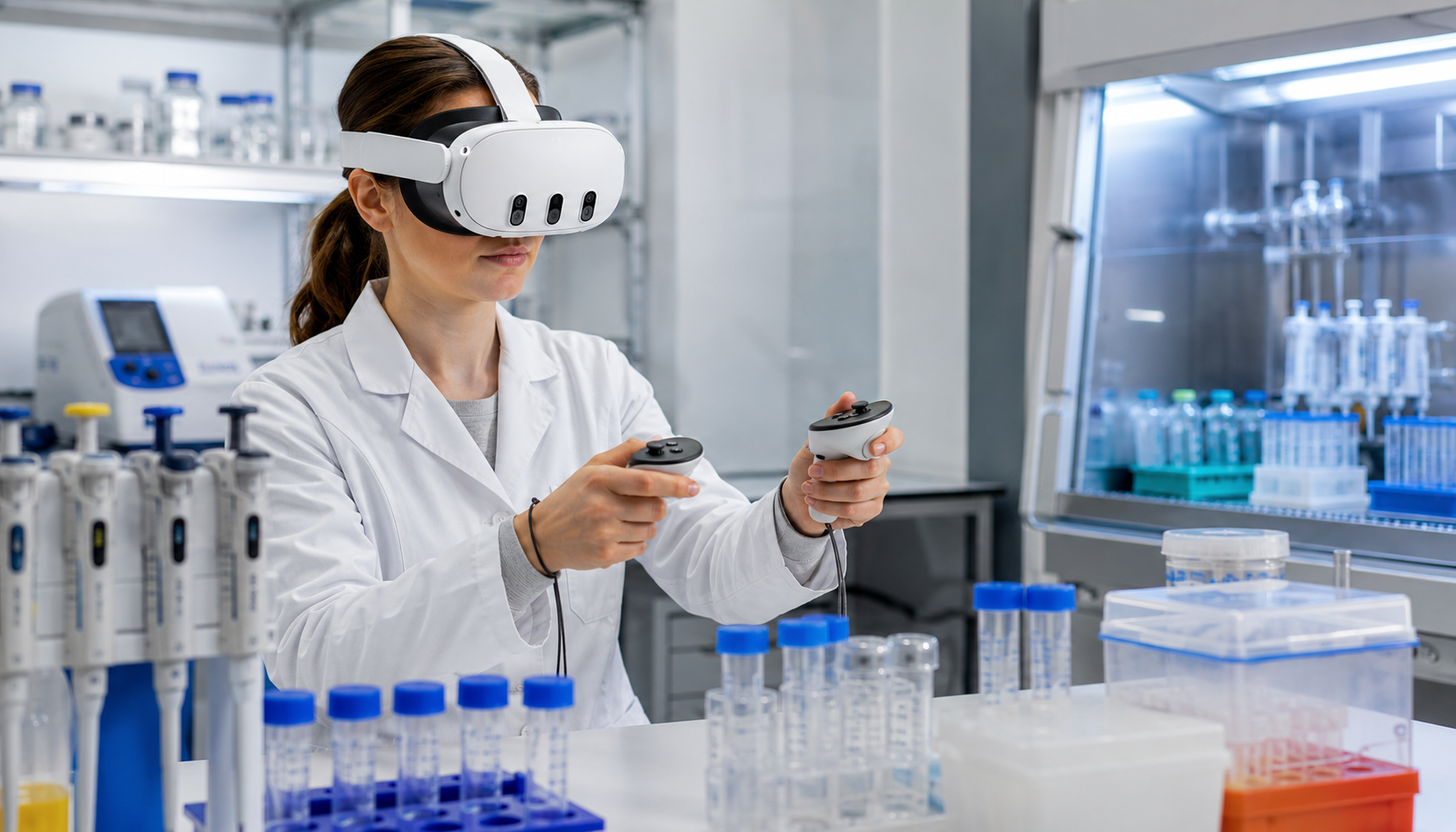
VR training is increasingly being used in life science settings to prepare researchers and technicians for work that is expensive, difficult to repeat, and sometimes impossible to practise on real samples or equipment. This guide pulls together the published research on how well it works, the main use cases that have been validated, and an honest look at the cost picture.
Why life science training is a particular challenge
Most professional training has some cost when things go wrong during practice. In life science labs, that cost is often unusually high. Reagents are expensive and sometimes irreplaceable. Samples can be months in the making. A contaminated cell culture or a pipetting error doesn't just waste materials; it can set a project back by weeks.
This creates a genuine problem for anyone responsible for training new scientists. You need them to develop real hands-on skill, but giving them access to the real environment to learn on carries risk. A lot of traditional lab training works around this by using proxy tasks or simplified versions of the real thing, which helps, but only goes so far.
VR training is being used in this context as a way to give people unlimited, consequence-free practice in a realistic simulation of the actual environment, before they work with real samples or equipment. The idea is that by the time they do their first real pipette transfer or their first biosafety cabinet run, they've already done it dozens of times.
What the research says
There is now a meaningful body of published research on VR training in laboratory and life science settings. Here is a summary of the most relevant findings.
Laboratory skills and performance
A meta-analysis of 21 studies involving 1,527 participants, published in Technology, Mind, and Behavior (APA Open), found an overall effect size of d = 0.510 in favour of VR-based training. The effect was strongest for skills outcomes specifically, where the effect size rose to d = 0.692. These are moderate to large effects by the conventions used in educational research, and they held across different types of laboratory skill.
On pipetting specifically, a study by Petersen et al. (2022) found that performance in a VR pipetting simulation can predict real-life pipetting performance. In a field study with high school students, VR training transferred to measurable real-world skill. The researchers are careful to frame VR as a complement to hands-on practice rather than a replacement, and the evidence supports that framing; VR gets people to a higher baseline before they ever touch a real pipette.
A randomised controlled trial published in Springer's Education and Information Technologies journal (2024) looked specifically at aseptic technique in cell and tissue culture, using an in-house VR application called AsepticTech VR. Students in the VR group showed better outcomes than the control group in both the cognitive domain (p < 0.05) and the psychomotor domain (p < 0.01). These are the two domains that matter most for lab work; knowing what to do, and being able to do it with your hands.
Safety training
A 2026 systematic review and meta-analysis published in ScienceDirect examined VR in laboratory safety training across the last ten years. The analysis found VR to be statistically superior to conventional methods across knowledge, skill, experience, and psychology domains. For behavioural outcomes, a sensitivity analysis showed a moderate effect size of d = 0.585.
The CDC piloted a VR training programme for biosafety cabinet (BSC) operation with 59 staff, including both experienced and inexperienced BSC users. Of participants with existing BSC experience, 94% agreed that the VR training gave them practical experience using a BSC. The CDC framed the result as evidence that VR training can improve learner confidence and teach laboratory skills.
Retention over time
One of the consistent findings across VR training research is that knowledge and skill retention holds up considerably better over time than it does with traditional instruction. Studies have found retention rates of around 80% a year after VR-based training, compared to 20–30% for conventional methods. In a lab context, where someone might be trained in January and need to apply that skill in October, this is a meaningful difference.
d = 0.692
effect size for skills outcomes (APA meta-analysis, 21 studies)
94%
of CDC pilot participants agreed VR gave practical BSC experience
~80%
knowledge retention after 1 year (vs 20–30% for traditional training)
Use cases in life science labs
The following are the areas where VR training has been most widely applied in life science settings, along with what the evidence and practice looks like in each.
Pipetting and liquid handling
Pipetting is one of the most important foundational skills in any wet lab, and one of the hardest to teach consistently. It requires fine motor control, attention to technique (angle, pressure, speed), and an understanding of how errors compound across a serial dilution or a multi-step protocol. Getting it wrong wastes reagents and produces inconsistent results.
VR pipetting simulators, including our own PipetteSim, allow learners to practise the technique repeatedly with immediate, objective feedback on their performance. Every session generates data on grip, angle, speed, and volume consistency, so a trainer or lab manager can see exactly where someone is struggling and what to focus on.
The research by Petersen et al. (2022) confirmed that the skills people develop in VR pipetting simulations transfer to real-world performance. Imperial College London has also documented a VR pipetting training programme as part of their digital lab skills curriculum, with the goal of getting students to a consistent baseline before they access wet lab time.
Beyond the learning outcomes, there's a sustainability argument too. Every hour of VR pipette practice is an hour not spent burning through pipette tips, reagents, and consumables. For large cohorts, that adds up.
Aseptic technique and cell culture
Aseptic technique is one of the more difficult skills to teach in life science labs, as it involves a combination of procedural knowledge, physical discipline, and constant vigilance. A single lapse in technique can contaminate a culture that took weeks to grow.
The AsepticTech VR application, developed for cell and tissue culture training, guides learners through a complete aseptic workflow: gowning, biosafety cabinet preparation, contamination checking, subculture, and wrap-up. The 2024 randomised trial found that VR-trained students outperformed controls on both cognitive and psychomotor outcomes. The psychomotor finding is especially important, as it suggests the physical discipline of aseptic work can be meaningfully developed in VR before someone enters a real lab.
Bristol Myers Squibb has used VR training for cell therapy technicians at scale, allowing staff to practise gowning, gloving, sterile tube welding, and first-air rules before setting foot in a physical training lab. The logic is the same; build muscle memory in VR so that the first real experience is a reinforcement, not a first attempt.
Biosafety cabinet operation
The CDC's biosafety cabinet VR training programme is one of the most well-documented examples of VR in life science safety training. The course covers identifying BSC components, maintaining positive airflow, preparing for work, safe working practices, decontamination, and emergency procedures.
The pilot results (94% of experienced users agreeing VR gave them practical experience) are worth noting, as the study group already knew how to use a BSC. The fact that experienced users still found the VR training valuable suggests it works as both initial training and refresher content, which is useful for any organisation that needs to evidence ongoing competency.
Animal handling
Animal handling training presents a unique challenge. The skills involved (restraint, injection technique, welfare assessment) require hands-on practice, but the consequences of poor technique fall on live animals. This creates an ethical tension that VR is well positioned to address.
VR animal handling and injection training, including our own Mouse Handling and Site Injection module, allows researchers to practise technique in a realistic simulation before working with live animals. This aligns directly with the 3Rs framework (Replace, Reduce, Refine) that guides the use of animals in research, as it reduces the number of animals used in training, and reduces the stress on those that are used by ensuring trainees arrive with a much higher baseline of skill.
For organisations subject to Home Office licensing in the UK or equivalent regulatory oversight elsewhere, being able to demonstrate that staff have completed structured, evidenced pre-training is increasingly valuable.
Instrument familiarisation
Many life science instruments are expensive, complex to operate, and available in limited quantities. Booking time on a confocal microscope, a flow cytometer, or an electrophysiology rig to train a new user is inefficient, and training on the real instrument carries the risk of damage or misconfiguration.
VR instrument training allows researchers to learn the instrument's interface, workflow, and common error states before they get near the real thing. The goal isn't to replace hands-on time entirely; it's to make that hands-on time much more productive, as the learner arrives already familiar with the basics.
Our Molecular Neuroscience VR Training covers patch clamp electrophysiology, PCR preparation, and related techniques with this logic in mind. Researchers practise the steps in VR, and then apply them in the lab with a clearer head and less time spent figuring out where to start.
The cost picture
VR training in life science labs doesn't have a simple cost structure, as it depends heavily on what you're building and at what scale. The broad picture is: meaningful upfront development cost, low or near-zero cost to run.
For off-the-shelf products like PipetteSim, the cost is a subscription or licence fee, which is generally accessible even for smaller labs. For custom-built training (for example, a VR simulation of your specific instrument, your specific facility, or your specific SOPs) the development cost is higher but the resulting programme is matched exactly to what you need.
A useful comparison: consider what it costs to run your current lab training. Factor in the time of the experienced researcher doing the training, consumables used during practice, instrument time that could be spent on actual research, and any samples or reagents lost to trainee errors. For most labs training a meaningful number of people each year, the economics of a well-designed VR training programme start to look quite different.
Research puts the crossover point at around 375 learners, at which scale VR training starts to be cheaper per head than equivalent classroom or hands-on programmes. At 3,000 learners over three years, the cost per person is typically around 52% lower. For CROs and larger pharma companies training significant numbers of lab staff each year, these numbers are worth running.
Onboarding time is another variable worth tracking. In manufacturing and lab environments, VR training programmes have been associated with reductions in new operator onboarding time of up to 50%, as trainees arrive at hands-on sessions with a much higher baseline than they would otherwise have.
Where VR works well, and where it doesn't
VR is a strong fit for life science training when the skill is procedural and repeatable, when real-world practice carries meaningful risk (to samples, animals, equipment, or the learner), when training consistency across a distributed team is difficult to achieve, or when you need documented evidence of competency before someone works in the real environment.
It's a less natural fit for skills that are highly interpersonal (supervising a junior, communicating findings, navigating a team lab), or for techniques that are so instrument-specific and variable that a generic simulation won't capture the relevant nuance. The research also suggests VR works best as a complement to hands-on practice rather than a wholesale replacement; the goal is a better-prepared learner arriving at the bench, not a learner who has only ever trained in VR.
If you're weighing up whether VR training is worth exploring for your lab or organisation, the most useful starting point is a clear description of the training problem you're trying to solve. From there, it's straightforward to assess whether a VR approach would address it.
Related Reading
- What Is Custom VR Training? A Complete Guide for L&D Teams
- How Much Does Custom VR Training Cost? A 2026 Pricing Guide
- How Life-Science Students Get Real Lab Practice Without the Lab: A VR Training Case Study
- Pipetting Training in VR: Building Lab Skills Without Wasting Reagents
- How CROs and Biotechs Cut Lab Onboarding Time with VR
- VR for Animal Handling Training and the 3Rs: Reduce, Refine, Replace
Sources
- Petersen, G. B., Klingenberg, S., & Makransky, G. (2022). Pipetting in Virtual Reality Can Predict Real-Life Pipetting Performance. Technology, Mind, and Behavior, 3(3).
- Meta-analysis of VR in medical/science education — The Effectiveness of Virtual Reality in Medical Education (ResearchGate, 2025)
- CDC — Virtual Reality Laboratory Training: Biosafety Cabinet Edition (OneLab REACH)
- Acquisition of aseptic techniques using virtual reality: a randomized trial on performance, emotion and experience (Springer, Education and Information Technologies, 2024)
- Student acceptance towards AsepticTech VR for cell and tissue culture aseptic techniques (International Journal of Educational Technology in Higher Education, Springer, 2024)
- A systematic review and meta-analysis on the effectiveness of VR technology in laboratory safety training and education (ScienceDirect, 2026)
- Pipette training in VR — Imperial College London case study
- Virtual Reality: Transforming Cell & Gene Therapy Training (LTEN)
- How AR & VR Are Revolutionising the Pharmaceutical Industry: A 2026 Guide (Roundtable Learning)
Let's talk
See what a VR training programme could look like for your lab.
From off-the-shelf pipetting practice to fully custom simulations of your own instruments and SOPs, we'll help you work out the right approach.
Talk to us