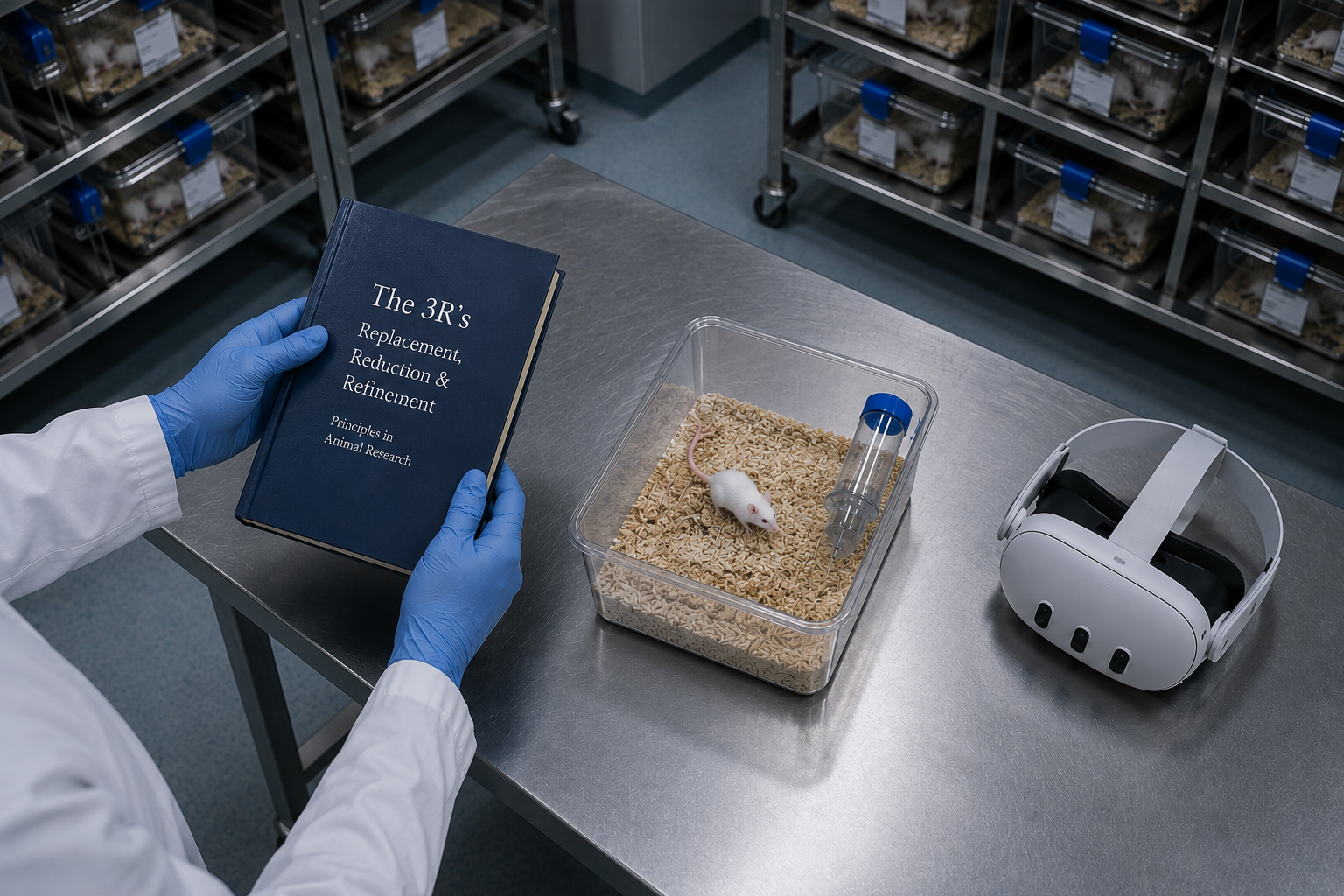
VR training directly supports all three principles of the 3Rs by giving researchers a way to practise mouse handling, restraint, and injection technique on a realistic virtual model before any live animal contact occurs. Moving repeated practice out of the animal facility and into a headset reduces the number of animals needed purely for training, refines the procedures that do take place by ensuring trainees arrive better prepared, and contributes to replacement where simulation can stand in for early-stage live animal contact. This post explains how each of the three principles maps to a VR training programme, what the evidence says about poor handling technique and its effects on animal welfare and data quality, and what Mouse Handling VR training covers in practice.
What the 3Rs ask of your training programme
The 3Rs (Replace, Reduce, Refine) were developed by Russell and Burch in 1959 and are now embedded in legislation across the UK and Europe, including the Animals (Scientific Procedures) Act 1986 and EU Directive 2010/63/EU. They set the ethical standard for all in-vivo research. The NC3Rs (National Centre for the Replacement, Refinement and Reduction of Animals in Research) is the UK's lead body for 3Rs science, and most animal ethics committees, institutional licensing bodies, and research funders expect to see how an organisation is actively applying them.
Replace
Replacement means avoiding or replacing the use of animals in areas where they would otherwise have been used. The NC3Rs divides this into full replacement (methods that use no animals at all, such as computer models, human tissue, or cell lines) and partial replacement (using animals not considered capable of experiencing suffering, or tissues from animals killed solely for that purpose). For training purposes, it raises a direct question: does a trainee need to practise scruffing, restraint, and injection on a live animal, or can a simulation give them the technical grounding they need before that point?
Reduce
Reduction means minimising the number of animals used per experiment or study. In a training context, this means reducing the number of animals that are used purely to build technique in new researchers. Every animal that is handled repeatedly because a trainee needs to practise a procedure is an animal that could, in principle, be accounted for by a well-designed simulation. Reducing this training burden on live animals is a direct application of the reduction principle.
Refine
Refinement means minimising the pain, suffering, distress or lasting harm that research animals might experience. The NC3Rs is explicit that training is a refinement method: a trainee who has repeatedly practised scruffing, restraint, and injection in a virtual environment will handle live animals with more confidence, less hesitation, and better technique. All of those things reduce the stress that animals experience during the procedure itself.
Why handling technique matters more than most teams realise
Poor mouse handling is not just an animal welfare concern. It is a data quality concern too.
Research published in Nature's Scientific Reports found that handling is a well-known source of stress to laboratory animals and that this stress can affect the variability of results and compromise animal welfare. Conventional tail handling in particular has been shown to induce anxiety and depression-like behaviour in laboratory mice, altering physiology and immunology in ways that impair the reliability and reproducibility of experimental results.
The NC3Rs has published extensive evidence showing that non-aversive handling methods, including tunnel handling and cupped hand techniques, significantly reduce these stress responses. Tunnel-handled mice show increased exploratory behaviour, lower defecation rates during testing, and greater willingness to interact with their handler. The effect is measurable, consistent, and directly linked to how well staff are trained in the technique.
The practical challenge is that non-aversive handling technique takes practice to do well. The NC3Rs notes that a common objection to implementing it is that the initial skill-building phase is considered too time-consuming, particularly in busy facilities. That is precisely the gap that VR training addresses: a trainee can repeat a procedure as many times as they need without any live animal involvement, building the physical confidence and muscle memory that makes the real-world version calmer and more controlled.
Research published in Scientific Reports (2020) found that the impact of handling technique and handling frequency on laboratory mouse welfare is sex-specific, with conventional tail handling inducing aversion, anxiety-like behaviour, and depression-like responses. Stress from poor handling can alter an animal's physiology and immunology, which in turn affects experimental outcomes. Handling is one of the most underestimated sources of experimental variation in in-vivo studies.
What Mouse Handling VR training covers
clear_pixel's Mouse Handling platform runs on a standalone Meta Quest headset and covers six core procedural modules:
- Scruffing technique
- Intraperitoneal (IP) injection
- Subcutaneous (SC) injection
- Tail vein (IV) injection
- Oral gavage
- Intracranial injection
Each module walks through the full procedure with guided feedback. Trainees can repeat individual stages independently, at their own pace, without any consumable costs and without any animal welfare implications. The platform needs no PC or lab setup: it runs on a single headset, ready to use wherever training needs to happen.
Ewha Womans University has incorporated clear_pixel VR platforms into their life sciences curriculum. Students arrive at supervised practical sessions already familiar with the procedural steps, reducing the time needed with live animals and improving the quality of technique from the first supervised session.
Where VR fits in a 3Rs-aligned training pathway
VR training is not a substitute for supervised live animal work. The goal is not to eliminate hands-on experience, but to move the early, repetitive, technique-building phase out of the animal facility and into a headset.
A straightforward training pathway might look like this: a new researcher first works through the VR modules until they have a confident grasp of the procedural steps. They then attend a supervised live session, arriving already familiar with the movements and the expected sensory feedback. From there they progress to more complex work under decreasing supervision.
That sequencing directly serves all three Rs. The researcher has replaced a portion of their early live animal practice with simulation. The facility has reduced the total number of animals involved in training. And the live sessions that do take place are more refined: the researcher is better prepared, and the animals experience fewer hesitant or repeated interactions.
It also fits with what regulators and ethics committees expect to see in a training plan. Being able to show that your programme uses simulation for initial skill-building before live animal contact is a clear demonstration that the 3Rs are being applied in a practical, substantive way, not just referenced in a policy document.
The NC3Rs on training as a refinement method
The NC3Rs is explicit that training is a refinement method. Their guidance on mouse handling lists appropriate training as one of the most direct ways to reduce the stress animals experience during routine procedures. They also note that well-trained staff do not add time to husbandry or procedures compared to those using conventional handling, provided the training they have received is adequate.
That qualifier matters. Training works when it is thorough and when trainees have enough repetitions to build genuine confidence. Traditional training relies on demonstration, observation, and then practising on live animals. There is no easy way to repeat a procedure ten times in a single session without animal welfare implications. VR removes that constraint entirely, making it possible to give every trainee the volume of practice they need before they set foot in the facility.
For any team taking the 3Rs seriously, that is worth paying attention to. The framework asks you to do more than acknowledge the principles: it asks you to demonstrate, procedurally, how you are applying them. A training pathway that incorporates VR before live animal contact is one that has a clear and defensible answer to that question.
Related Reading
Sources
- NC3Rs: The 3Rs
- NC3Rs: Mouse handling
- NC3Rs: Tunnel handling improves the welfare of mice undergoing repeated procedures
- NC3Rs: Implementation of non-aversive mouse handling for welfare refinement and reduction of mouse numbers
- Scientific Reports (2020): The impact of handling technique and handling frequency on laboratory mouse welfare is sex-specific
- BioMed Central Innovation and Education (2020): Experiential learning with virtual reality: animal handling training
Let's talk
Ready to build 3Rs-aligned training into your programme?
We'll walk you through Mouse Handling VR training and how it fits alongside your supervised practical sessions.
Contact us